Author

amw

Browsing

If only we could time travel to ancient times and see how the Greeks Gods, Egyptian Pharaohs, and powerful Vikings lived! It’s incredible to imagine that dinosaurs once roamed our Earth, other than what we read to our kids in books and see in the movies.

The next best thing to travelling to ancient sites is visiting a museum, and showing your children first-hand some amazing objects. Yes, they’ll learn history in school with their peers, but rather than learning from textbooks and lectures, the museum can take them away to faraway lands.

Introducing your kids to a museum opens up a world of imagination and exploration, and helps broaden their knowledge about the world we live in. The museum offers kids a space to explore their own curiosities, be inspired and learn through interactive exhibitions and hands-on play.

The Royal Ontario Museum is a must-visit for history buffs, tourists, and families. Since 1912, the ROM has accumulated more than six million objects, making it Canada’s largest museum of art, world cultures and natural history.

There is so much to see in the museum that it is nearly impossible to explore every exhibition in one day. Especially when you have children, they can maybe manage through two hours at a time before they are completely spent. But there is so much more to explore!

ROM Family Membership

A ROM family membership is the best value for visitors to explore the museum at your leisure. For what it would cost you to visit a couple of times, you can easily buy a family membership and enjoy free access to all the exhibitions at the museum year-round.

Here are some amazing things to do with the family at ROM:

Explorer Passport

This is a super fun and exciting way for children of ROM Members to experience the museum. Kids are welcome to pick up an Explorers passport, and then have it stamped every time you visit and when you complete a bonus stamp activity. Kids can earn stamps and win prizes each time a page is filled (5 stamps per page – only one prize per page).  The top prize is when you collect 40 stamps – you get a special behind-the-scenes tour with a ROM expert.

Kids and Family Programs

When you have a family membership, kids can enjoy free programs and activities during March Break, Family Weekends, ROM for the Holidays and more. ROM Members receive advanced booking and discounts on a variety of kids’ programs too, which is great savings for parents

Special Exhibits

Travel back in time over 1,000 years and explore the Viking footprint in Canada. Exclusive to the ROM, VIKINGS: The Exhibition, dives into the archaeology and history of the Norse on our East Coast. Follow their journey across the Atlantic and discover some of the myths and mysteries of these ancient peoples.

A Family Membership at the Royal Ontario Museum is So Worth It!

Explore the brilliance behind Christian Dior’s dramatic creations that revived the Paris haute couture industry after the devastation of the Second World War in ROM’s original exhibition, Christian Dior. Senior Curator, Dr. Alexandra Palmer, draws from the ROM’s extensive collection from the first ten years of Christian Dior haute couture, 1947 to 1957, to offer captivating insights into the creative process and mechanics of the fashion industry in Paris during a pivotal time.

Royal Ontario Museum - Christian Dior

Member Experiences

There are also free member experiences and previews exclusively for ROM Members, as well as free weekend admission to other attractions around the city including the Bata Shoe Museum.

A Family Membership at the Royal Ontario Museum is So Worth It!

Membership Benefits

  • Unlimited free admission to ROM galleries and exhibitions
  • Unlimited free admission to special ticketed exhibitions*
  • Free Coat Check
  • Previews of select exhibition and gallery openings
  • Subscription to ROM magazine
  • Discounts on select programs, lectures, and special events
  • Advance booking opportunities for special ticketed programs and events*
  • Discounts at ROM Boutique and Druxy’s ROM Café*
  • Discounts on select Gift Membership Levels*
  • Special Member-only discounts at local cultural institutions
  • Free general admission at select Canadian Museums*
  • Monthly eNewsletters to keep you up-to-date
  • Travel opportunities to destinations around the world*

*Some restrictions apply. See here for pricing information and membership levels.

For a family with two adults and 4 children (17 and under), the cost is $161 for one year, or $291 for two years. A ROM family membership is the most cost-effective way to see all of what the museum has to offer, and enjoy a fun, interactive and educational experience with the family.

A Family Membership at the Royal Ontario Museum is So Worth It!

Disclosure: This post is proudly sponsored by the Royal Ontario Museum. As always, the opinions expressed herein are my own.
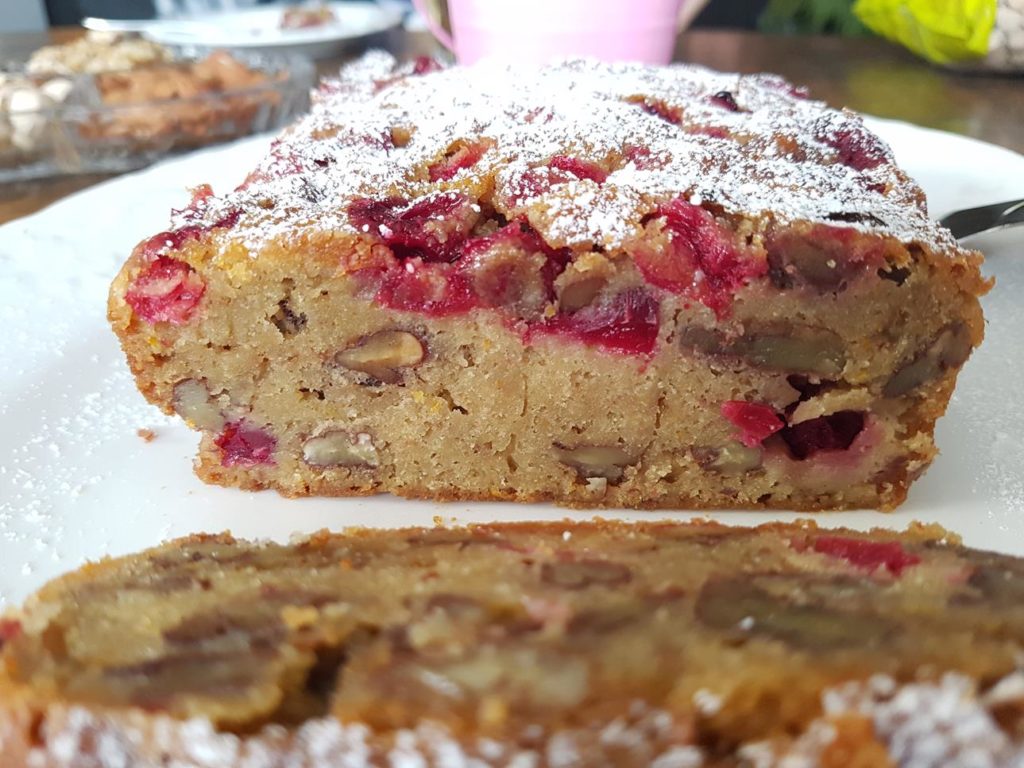
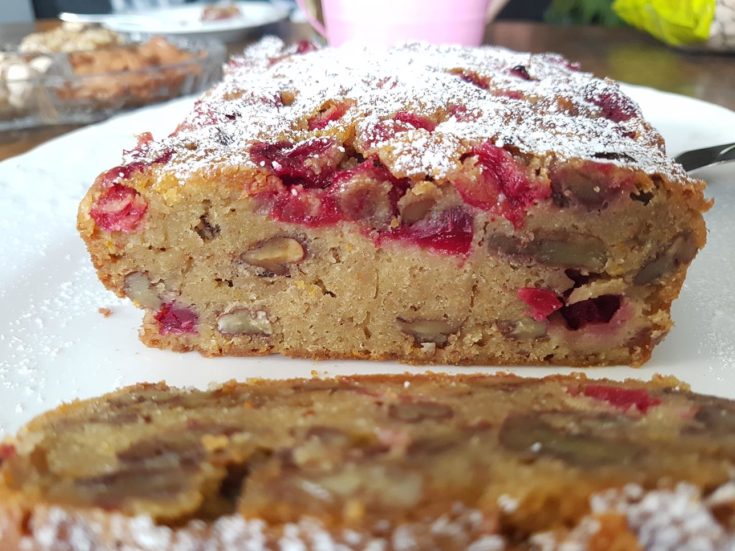
When we think of cranberries, our minds traditionally go to Thanksgiving or Christmas. But cranberries’ tart, sour taste that can be enjoyed in recipes year-round. Full of powerful phytochemicals that protect your body from illness, these berries taste so amazing in baked treats. Add a splash of orange with the crunchy rich flavour of pecans, and you have a delicious dessert.

I love a good pound cake, and this one happens to be gluten-free. Here’s my recipe for gluten-free cranberry pecan loaf. You can simply swap out the gluten-free flour with regular flour if you’re not gluten-free.

Gluten-Free Cranberry Pecan Loaf

Ingredients

¾ cup chopped pecans

1 cup cranberries

1 cup sugar

½ cup unsalted butter, room temperature

3 eggs

2 tablespoons sour cream

2 tablespoons orange juice

1 teaspoon vanilla extract

½ tablespoon grated orange peel

1 cup gluten free flour (1/4 cup each almond, sorghum, tapioca and brown rice) + 2 tablespoons

Pinch of salt

Gluten-Free Cranberry Pecan Loaf

Method

Preheat oven to 350. Place pecans on a cookie sheet and bake for 10 minutes. Cut half of the cranberries in half.

In a stand mixer, beat together sugar and butter until light and fluffy. Beat in eggs, one at a time. Then add in sour cream, orange juice, vanilla and orange peel.

In a separate bowl or measuring cup, stir together flour and salt. With mixer on low, add the flour until blended well.

Pour into a prepared loaf pan (butter and floured or parchment paper lined). Back at 350 for about 40 minutes to an hour, or until toothpick comes out clean.

Enjoy!

Gluten-Free Cranberry Pecan Loaf

Yield: 1 loaf

Gluten-Free Cranberry Pecan Loaf

Gluten-Free Cranberry Pecan Loaf | amotherworld

I love a good pound cake, and this one happens to be gluten-free. Here’s my recipe for gluten-free cranberry pecan loaf.

Prep Time 10 minutes
Cook Time 1 minute
Total Time 11 minutes

Ingredients

  • ¾ cup chopped pecans
  • 1 cup cranberries
  • 1 cup sugar
  • ½ cup unsalted butter, room temperature
  • 3 eggs
  • 2 tablespoons sour cream
  • 2 tablespoons orange juice
  • 1 teaspoon vanilla extract
  • ½ tablespoon grated orange peel
  • 1 cup gluten free flour (1/4 cup each almond, sorghum, tapioca and brown rice) + 2 tablespoons
  • Pinch of salt

Instructions

    1. Preheat oven to 350.
    2. Place pecans on a cookie sheet and bake for 10 minutes. Meanwhile, cut half of the cranberries in half.
    3. In a stand mixer, beat together sugar and butter until light and fluffy.
    4. Beat in eggs, one at a time.
    5. Then add in sour cream, orange juice, vanilla and orange peel.
    6. In a separate bowl or measuring cup, stir together flour and salt. With mixer on low, add the flour until blended well.
    7. Pour into a prepared loaf pan (butter and floured or parchment paper lined).
    8. Back at 350 for about 45 minutes to an hour, or until toothpick comes out clean.

Nutrition Information:

Yield:

8

Serving Size:

1

Amount Per Serving: Calories: 312Total Fat: 21gSaturated Fat: 9gTrans Fat: 0gUnsaturated Fat: 11gCholesterol: 102mgSodium: 46mgCarbohydrates: 29gFiber: 2gSugar: 27gProtein: 4g

By the time your children become teenagers, they should have a pretty good understanding of money… perhaps spending rather than saving! It’s important that teenagers recognize the value of money and understand that it is not an unlimited resource.

One of the first questions young children ask parents is a variation of, “does money grow on trees?” That is one of the earliest conversations about money you’ll likely have with your kids. My school-aged kids once asked me, “Mom, does that card just give you money?” That question led to further discussions about working, earning, and saving money. Now with my own two boys entering their teenage years, it’s time to further educate them.

Where do parents begin? Here are some ways to teach your teenagers about saving money:

Monthly Budget

If you haven’t already started your teenager on an allowance, now is the time to consider. For younger teens unable to get a part-time job yet, consider giving them opportunities to earn money for spending by doing chores around the house, and babysitting. Money that is earned is most always more valued than money that is given. Instead of handing bills when they ask for cash to go out for lunch or movies with friends, give them a specific amount each month. This will teach them to budget and control their spending.

Part-time Job

Nothing teaches money skills faster than earning a pay cheque! Once your teen is ready to enter the job force, discuss what will happen after receiving that cheque; how much will go into his/her pocket, and how much will go into the bank account.

Setting Goals

Have your teen write down what their financial responsibilities are, such as paying for cell phones or car insurance; and what their financial “wants” are, such as money for purchasing clothes, or hanging with friends. You can help them create a budget that determines how much they need to pay for bills, and how much they have left over to spend on fun things.

When you teach kids how to prioritize and plan using a budget, and when they understand that they need to pay the important things (bills) first, they’re more likely to save, knowing that there is money set aside in their budget for fun stuff, too.

Match Kids’ Savings Deposits

Most teens find it more enticing to save money when parents can match a percentage of their own savings. You can make a “rule” that a certain percentage of their earned income or cash gifts goes into a savings account – a good rule of thumb is 10%.

Let them know that their deposits are secure thanks to federal deposit insurance. The Canada Deposit Insurance Corporation (CDIC) is a federal Crown corporation that protects deposits at banks and other financial institutions that are CDIC members, up to CDN $100,000 (per deposit category), in case of a bank failure.

Eligible deposits include:

  • Savings accounts
  • Chequing accounts
  • Term deposits, (such as GICs) with original terms to maturity of five years or less

But not everything is covered. Teenagers may not be banking beyond basic accounts, but it is important to note (for us parents, too!) that accounts and deposits not protected by CDIC include:

  • Stocks, bonds and mutual funds
  • Digital currency (like Bitcoin)
  • Deposits in foreign currency

Explaining CDIC and deposit insurance to teens can help them understand where their money is saved. Here is a helpful animated video you can watch together to help them better understand.

Create Other Rewards for Saving

Teens also might be encouraged to save more if parents implement other types of reward programs. You can talk to them about ideas for savings – this interactive video is a great way to open the discussion around saving for the future. Upon graduating high school, you receive $50,000 and you choose what to do with it – what do you do?

Ideas for savings rewards for your teen can include helping buy for a vehicle, college/university tuition if they save up a certain amount first.


By teaching teens the importance of saving money, and budgeting their spending, you give them the power they need to spend and save in ways that are most important to their individual goals.

Teaching Your Teenager About Saving Money | amotherworld.com

Disclosure: This post is proudly sponsored by CDIC. As always, the opinions expressed herein are our own.

What type of parenting style do you have? As a parent, you likely fit into one of the many parenting styles that have been created, some of which have been debated amongst parents for a long time.

Authoritative parenting

Authoritative parenting is when parents encourage children to be independent but still place limits on their actions, and will set standards for their behaviour. Parents understand how their children are feeling and teach them how to regulate their feelings, helping them to find appropriate outlets to solve problems. They also expect mature, independent, and age-appropriate behaviour, and will punish for misbehaviour, not arbitrary or violent.

Authoritarian parenting

Authoritarian parenting is demanding without direction, explanation or feedback on the child’s behaviour. Corporal punishment, such as spanking, and shouting are forms of discipline frequently preferred by authoritarian parents. The goal of this style of parenting is to teach the child to behave, and ultimately be prepared to survive and thrive in the real world.

Indulgent parenting

Indulgent parenting, also called permissive, non-directive, lenient or libertarian, is a style of parenting in which parents are very involved with their children but place few demands or controls on them. Parents are nurturing and accepting, and are responsive to the child’s needs and wishes, acting more as a “friend” than a disciplinarian. The expectations of the child are very low, and there is little discipline. Permissive parents also allow children to make their own decisions, giving them advice as a friend would. This type of parenting is very lax, with few punishments or rules.

Freestyle parenting – off grid parenting

There is also another newer style of parenting, even more, lenient than lenient/indulgent parenting perhaps, which is known as free-range, freestyle parenting or “off-grid” parenting. This is a laissez-faire style of parenting and includes ditching traditional concepts like bedtimes, modern medicine, potty-training and even school.

When it comes to education, these parents’ off-grid method involved not even homeschooling, but unschooling, a somewhat newer term in which kids learn things they want to learn and at their own pace. Parents teach these children what they believe is important, opting out of the more traditional curriculum practised in the school system and even homeschooling. Instead of engaging with other children in classrooms, their “freestyle” education has these children choosing their own learning subjects, even if that means painting or playing outside.

The parenting method that lets kids make the decisions all on their own, without any rules or regulations, or input or guidance from their parents. This mother of three Vickie, from Hull, U.K. practices ‘unschooling’ with her children, according to the BBC. She has taken her children out of the school system and allowed them to decide what to learn on their own schedule. Even more, the kids decide what and when to eat, and when to go to bed.

Watch the video to learn more:

What do you think about this style of parenting?


Looking your age is less about trying to be someone you’re not, and more about being comfortable and confident in your own skin. No matter how young or old you are, we can agree that we all want to look and feel our best.

Do we want to look younger than our age, or not look older? Thanks to advances in science and medicine, people are living longer and looking younger in the process. Many women feel their best when they look their best; they also want to look their best without anyone noticing that they’re trying to!

While some women want to fight aging, and others hope to look younger, I think many women want to look and feel their best for their own age. I personally don’t feel I need to look like I’m in my 20s again, but I would like to look and feel the best that I can for my 40s.

Research shows Canadian women work to enhance their look not for social acceptance, but because it makes them feel more confident.  In fact, 71 per cent say they make the effort to look good first and foremost for themselves – validation from others matters less.  With this unique approach to facial aesthetic treatments, women can now unapologetically ask for exactly what they want and have it all on their own terms.

Dr. Mauricio de Maio, an internationally renowned facial aesthetics expert, who has travelled the world educating fellow physicians on how to make woman feel and look great, has pioneered an innovative way to treat lines and wrinkles that focuses on feelings first. De Maio coined the term, MD Codes, which considers the full face and recognizes that individual areas of the face are inherently linked to specific emotional attributes.

Looking Your Best is Feeling Your Best | amotherworld.com

I sat down with Dr. de Maio to talk about his approach to helping women feel and look great.

What makes your approach unique?

Dr. de Maio: The difference is that I try to bring a system. The MD Codes are what everyone was injecting but not what I would call intuitively; they’d see lines and empty spaces. I started creating a system where they would know clearly why they were injecting, where, how much.

Why have fillers become mainstream?

Dr. de Maio: Because we need them. I compare them with teeth. Over the years dentistry has improved; not only did we learn to fix the decay early, we also learned how to improve quality and make them whiter. Go back and look at your grandmother and the mothers of your grandmothers. And now look at the women in their 60s now – they are different humans. There is a big difference, because the world has changed. We have more access to new technologies, techniques and products. We have more resources to reach better, even more and more use.

Looking Your Best is Feeling Your Best - amotherworld

What do you say to someone who says you should age naturally?

Dr. de Maio:

If you interfere with your aging process, if you exercise and protect your skin, if you take care of your health, you reach the age of 80 differently. I personally don’t see teeth, health and aesthetics as separate entities.

What do people look for when they come to see you?

Dr. de Maio:

The people that visit are a select group of people that feel that appearance is important. When I travel around the world, I see many people undertreated. If you go to big cities, people are treated but the vast majority are untreated. When people say, “Mauricio what are people looking for?” I say people want to look better, whatever that might be; some people want to look less tired, more attractive – that’s why I created the emotional attributes, the main objective for your appearance.

If I came to see you for a consultation, what would you say to me?

Dr. de Maio:

Maria, look at the mirror and point three areas you’d like to treat, one is most important to you:

My answers:

1.       Lip lines

2.       Crow’s feet

What I notice is your personality – I look at your age and your face and I scan it. Then I put those on a scale from 0 to 10; with 10 as your best. And I never disclose it. Then when you visit me, I will try to improve the number. Then I listen to what you tell me; then I look to see if I can increase that number. In your case, the lip lines and crow’s feet are not strong enough.

Now at your age, what would you like to achieve with these treatments? You have to choose three things:

1.       Less tired

2.       Less sad

3.       Less saggy

4.       Less angry

5.       More attractive

6.       Younger

7.       Slimmer

8.       More feminine

My answers:

1.       Slimmer

2.       Younger

3.       Less Sad

Dr. de Maio:

You didn’t hesitate here as much as you hesitated with the first question; what is interesting is that what you asked of me and the attributes you chose didn’t match.

You have great genetics; you look younger for your age, so you have the positives. And when I look at your negative messages, you don’t have downgrading factors. Let’s suppose I had another 42-year-old woman beside you. The secret of good appearance is good genetics and absence of negative messages; you don’t look tired, you have a positive image. You were born with it. Unfortunately not everyone has it and this is where this other woman who wasn’t born with it needs help.

And you need to preserve what you have; for you in consultation I would say let’s talk about what to do to preserve your attractiveness and youthfulness in the years to come. And I would try to preserve your budget. That’s what you’d expect from good professional – to tell you, don’t spend your money where you don’t need it.

The signs of aging are inevitable for all of us. Luckily for many people who want to prevent these signs from becoming too prominent, wrinkles and loss of fullness in the face can be treated with fillers like Juvéderm®.

Juvéderm is a family of facial fillers used by your cosmetic doctor to refresh your appearance by smoothing away unwanted lines and bringing back the natural contours of your face. Others use it for lifting the cheeks, plumping the lips, filling loose or sagging skin, and ultimately hoping for a subtle younger look.

There is a misconception about this treatment because some people have overdone the use of fillers, and end up looking different; but when expertly injected, filler should look natural. The goal is to plump and lift in other parts of the face for a more natural-looking result – to look like yourself, but a slightly refreshed version.

Dr. de Maio’s approach of helping women determine how they want to look and feel is innovative and unique. The ultimate goal when considering a treatment is not only to look your best but feel your best – at any age.  

For more information on fillers, or to find a local registered aesthetic medicine professional, visit Juvederm.ca.

This post is proudly sponsored by Allergan Canada. As always, the opinions expressed herein are my own.


When visiting Greece, many tourists choose to explore the Greek islands in the Aegean sea. But it’s worth a visit to the other coast of beautiful Greece, and the islands of the Ionian sea – where one of my favourite Greek islands is situated. Zakynthos.

Zakynthos is a popular tourist destination, with an international airport served by many charter flights from northern Europe. The island’s nickname is To fioro tou Levante The flower of the East, given by the Venetians.

It’s tough to narrow down all the amazing places and sites to see while visiting Zakynthos because there truly are many! But here are the top 5 Stunning Spots in Zakynthos Greece you must see:

5 Stunning Spots in Zakynthos Greece

Navagio Beach

Zakynthos attracts many beach lovers, with its most famous landmark  being Navagio beach. Isolated by high cliffs and accessible only by boat, Navagio is a small cove on the northwest shore. It’s named after a shipwreck (MV Panagiotis) which sunk on the shore around 1980. The ridge area from Anafonitria has a small observation deck which overlooks the shipwreck. The beach and sea floor are made of white pebbles, and surrounded by turquoise waters.

Navagio Beach Zakynthos Greece

Blue Caves

Another must-visit attraction in Zakynthos is the natural “Blue Caves”, cut into cliffs around Cape Skinari, and accessible only by small boats. My family and I were supposed to tour the caves, but sadly the tour boat operator wasn’t forthcoming with the timing of the tour. Traveling with seniors and kids, a six-hour trip when we had anticipated a two-hour tour, wasn’t ideal in the evening hour. If you do plan a boat tour of the blue caves, make sure it’s early in the day, giving yourself plenty of time.

Blue Caves Zakynthos Greece

Tsivili Beach

While the largest resort of Zakynthos is Laganas, we found it to be too touristy and busy. I also found the area to be tacky and obnoxious. I much preferred the quieter, family-friendly Tsivili beach. Tsivili is also closer to the downtown of the island, only a 5 minute drive. Since we had a car, we were able to tour the island freely. Tsivili main streets are lined with restaurants, souvenir shops and tour booths.

Tsivili Beach Zakynthos Greece

Bochali

Bochali hill above the Zakynthos town contains a small Venetian castle and offers panoramic views of the town. Located next to Bochali, Strani hill is the place where Dionysios Solomos wrote the Greek national anthem. You have a gorgeous view of downtown and the boats.

Bochali Zakynthos Greece

Downtown

The harbour city of Zakynthos is the capital and major hub, centered around waterfront Solomos Square. The houses, shops and buildings were rebuilt in Venetian Style after the destructive earthquake of 1953 that ruined the majority of the buildings. The architecture and style has been influenced in part by the Venetians, the French and the English who have all, at some time in history, occupied the island. There are lovely shops and restaurants to discover.

Downtown Zakynthos Greece


If you plan on visiting Greece, make sure to visit these 5 Stunning Spots in Zakynthos Greece!

Written by Dawn Alsept

I never planned on being a special needs mom.  I don’t think any of us do, it takes most of us completely by surprise.  In fact, I remember thinking for many of my childbearing years that I felt so bad for moms who had a child with special needs.  Poor moms.  Well, life has a way of surprising you and now I am on the other side of that coin.  Here is what I want you to know (and I am sure that there are many other moms who feel this way too).

What One Special Needs Mom Wants You to Teach Your Children | amotherworld.com

Teach Your Children to be Friendly

There is nothing worse to a special needs mom than children and adults who look away and do not acknowledge you.  Be friendly and smile, don’t avoid eye contact.  Our children notice this, we notice this, and it hurts.  Teach your children to smile at others and even wave hello.  Even if our children cannot wave back, we notice and it makes our hearts smile.

It’s Okay to be Curious

Teach your children to ask questions, but help them word the questions politely.  When your child whispers to you, “what’s wrong with that little girl/boy,” use this as a teaching moment.  Don’t scold your child, but rather, tell them to ask about the child in question.  They can phrase the question like this, “tell me about your little boy.”  I would love it if instead of a mom shushing her child and walking faster, the parent took the lead and started with a compliment such as, “what a cute shirt, tell me about your little one.”  This opens the door for conversation, the parent of the special needs child can then tell you as much, or as little, as they want to.  Ask about a device you are unfamiliar with such as, “Can you tell my son how the braces help your child walk better?”

Watch Your Language

Parents of children with special needs typically dislike the term NORMAL.  So, don’t refer to the child saying something along the lines of…”how is he/she different than NORMAL kids.”  There really is no normal with children, there is typical but I think every child can, at times, be a bit abnormal if you ask me.  We special needs parents also prefer person-first language.  My child is not a Downs Child, he is a little boy with Down Syndrome.  See what I mean?

Your Children Learn From You

Our children are like sponges, I am sure you know this from the last time your son/daughter spouted off something that you know you have uttered before without realizing they heard you.  This means that when they observe you interacting, without fear, they will likely do the same.  If you are at a public venue and see a parent with a child who has special needs, strike up a conversation with the parent or child. Your children, over time, will come to view this as normal behavior and realize that people who are different are not scary.

Remove the Fear

Sometimes when your child views behavior that may frighten them, say an adult or child with special needs who may yell or act out in a manner that your child is unfamiliar with, have a chat.  Talk to your child and, as best you can, discuss what may cause the disability you are observing and follow that up with a statement to reassure your child.  Sometimes children do not understand that what they are seeing is not something that they can “catch”  like a cold, it is not contagious.  Also talk with your child about how people communicate, not everyone is able to talk like they are but everyone has a way to communicate, some are just louder than others.


Ultimately, what I want you to know is that special needs moms have the same ups and downs as parents of typical kids.  We like to be included and we feel isolated when no one reaches out to us.  The only way to make our world a more inclusive and accepting place is to start by reaching out to one and other, and what better way to do that than to start with our own children.

Dawn is the homeschooling mom to 6 of God’s blessings and the wife to a husband she counts as her best friend.  She and her husband enjoy life on a small family farm where they strive to grow their own food, raise their own livestock, and homestead to the best of a modern day family’s ability. Though she loved running a homesteading blog for years,  at www.incidentalfarmgirl.com, she discovered a new passion with the birth of her 6th child who surprised the family with a Down Syndrome diagnosis at birth.  Now she spends her free time writing, advocating, and sharing stories to bring awareness to Down Syndrome at www.cedarsstory.com.


It’s been years in the making… and it’s finally here!

Introducing, my new baby!

Oh Baby! A Mom's Self-Care Survival Guide for the First Year: Because Moms Need a Little TLC, Too!

Oh Baby! A Mom's Self-Care Survival Guide for the First Year: Because Moms Need a Little TLC, Too!

Oh Baby! A Mom’s Self-Care Survival Guide for the First Year: Because Moms Need a Little TLC, Too!

You read all the birthing books, took the Lamaze classes, and made it through labor (mostly) unscathed, but now the baby is home—and it’s a whole new ballgame! There are plenty of books and resources about how to properly care for your new baby, but what about caring for yourself?

My book outlines the “proper care and feeding” of mothers during their baby’s first year. From the physical and emotional changes a new mom will undergo to rekindling intimacy with your partner, Oh Baby! A Mom’s Self-Care Survival Guide for the First Year keeps the focus on moms—because you can’t draw water (or breastmilk, for that matter) from an empty well.

Oh Baby! A Mom’s Self-Care Survival Guide for the First Year: Because Moms Need a Little TLC, Too! will be released March 1, 2018! My book is now available for pre-order at the following:

Amazon.ca

Chapters-Indigo

Amazon.com

Barnes & Noble


Please support my book by pre-ordering now!

Women dominated the 75th Golden Globe Awards – and it’s about time. The solidarity of women was just one of the winners of the night, with actresses dressed in black as a symbol of protest at injustice throughout the film industry. The night was amplified by the #MeToo and #TimesUp movements, and the personal stories that drive them.

Even more, the biggest winners Sunday night were films and television series that center women featuring strong female narratives – Lady Bird, Three Billboards and The Shape of Water on the big screen, and Big Little Lies, The Handmaid’s Tale and The Marvelous Mrs. Maisel on television.

And then there was Oprah. What is there to say about this outstanding, powerful woman, role model, and future President of the United States? Oprah received the honorable Cecil B. DeMille Award and used the opportunity to deliver a powerful speech that will be remembered for a long time.

The OWN founder, former talk show host, actress, film and TV producer and humanitarian became the first black woman to be given the award. She recalled the moment that would change her future – as a young girl watching Sidney Poitier, the first black man to win the best-actor Oscar in 1964. And here she stood herself, referencing the young girls who may be watching her accept her Award and being the first African-American to do so.

She tied that vision to the prospect of young girls today seeing her get her DeMille Award — and being the first African-American woman to do so. Oprah covered many important issues in her speech, including today’s press, civil rights and violence against women. She celebrated women who were brave enough to tell their stories.

“I want to say that I value the press more than ever before as we try to navigate these complicated times, which brings me to this: What I know for sure is that speaking your truth is the most powerful tool we all have. And I’m especially proud and inspired by all the women who have felt strong enough and empowered enough to speak up and share their personal stories. Each of us in this room is celebrated because of the stories that we tell, and this year we became the story.”

She shared the tragic story of Recy Taylor, a woman who brought her brutal rape case to the attention of NAACP officials including Rosa Parks, who investigated the crime in a time and “culture broken by brutally powerful men. Women were not believed.”

But that time is over, Oprah told us. She said that the reign of abusive men was coming to an end: “Their time is up!” More work needs to be done – not just in Hollywood, but in all industries.

I went to a Live with Oprah show in 2013 and even had the honour of meeting her (ever so briefly). Watching her speak is so empowering and enlightening, and she is one of the few people who can make you feel as though she is speaking directly to you. She courageously told her story long before any movement for others, and has always been a fierce advocate for women. 

Oprah has the natural ability to unite us all, despite race, religious, gender, political view or workplace. This new movement is just beginning – let’s hope it can create real change.

So I want all the girls watching here and now, to know that a new day is on the horizon!  And when that new day finally dawns, it will be because of a lot of magnificent women, many of whom are right here in this room tonight, and some pretty phenomenal men, fighting hard to make sure that they become the leaders who take us to the time when nobody ever has to say ‘Me too’ again.


Who is Logan Paul and why should I care?

If you are a parent of a tween or teenager, you’re going to want to know if you don’t already.

The 22-year-old is one of the world’s biggest social media stars who has more than 15 million subscribers on his popular YouTube channel. The vlogger is popular with youngsters; my 13-year-old is a fan, as are many of his peers.

Recently, the YouTuber shared a video where he discovered a corpse of a suicide victim in Japan’s Aokigahara forest, and then laughed about it.

“Bro, did we just find a dead person in the suicide forest?” he says in the now-deleted video.

Paul uploaded the video which was seen by six million of his fans, mostly young ones. Paul deleted the video less than 24 hours after it appeared on his channel, but the video had been accepted by YouTube’s reviewers, even though it had been flagged by viewers.

But six million people had already seen the video – six million mostly young, impressionable people. These youngsters watch Paul and his friends who joked about finding a dead person, rather than showing empathy and sorrow. The deceased man took his own life; to post this anywhere, even though he face had been blurred, is disgusting and immoral.

Paul and his group showed complete disrespect to the man and his family. There was also no thought of how publishing the video would affect his fans, again mostly young people.

Showing suicide in this manner, including sensationalizing such a tragedy, was irresponsible and potentially dangerous.  Suicides have become the second-leading cause of death among teenagers in the United States.

Do we want our kids to grow up being completely desensitized to death and tragedy? No… our hope is to have children who value and appreciate life, and can show empathy and kindness. Teaching empathy to children is one of the most important lessons parents can give. We can encourage older children to more actively put themselves in other people’s shoes.

We can help them understand how others may feel in actual situations, but also hypothetical scenarios too. “How would that make you feel”? and “Put yourself in his/her shoes – what would you be feeling?” are simple ways to help practice understanding and empathy for others.

Suicide should never be funny, especially in a video that teenagers would be watching. Paul faced global backlash and criticism, forcing him to issue an emotional apology for showing the video.

“The reactions that you saw on tape were raw, unfiltered,” Paul said. “None of us knew how to act or feel. I should have never posted the video, I should have put the cameras down and stopped recording what we were going through. There were a lot of things I should have done differently, but I didn’t. And for that, from the bottom of my heart, I am sorry.”

He then announced on Twitter that he would step back from YouTube to reflect on everything that has happened over the past few days. Unfortunately, the apology comes a little too late for many.