

Your child is almost two years old and not talking. You’re worried but not sure what to do. Most of your friends and family tell you not to worry: “He’ll talk when he’s ready”, but you can’t let it go.
I was concerned when my eldest son wasn’t saying much at 18 months. I asked his paediatrician who told me it was up to me; I could act now, or wait until two years old before taking any action. My motherly instinct told me to act right away. My son’s frustration due to his lack of being able to communicate was intensifying and I didn’t want to delay it any further.
The doctor referred me to The Hanen Centre, a not-for-profit authority in the development of family-focused early language intervention programs and learning resources. I enrolled in the It Takes Two to Talk® program which helps to enable parents to become their child’s primary language facilitator, thereby maximizing the child’s opportunities of developing communication skills in everyday situations.
“As a parent, there is nothing worse than the feeling that you can’t do something yourself,” says Elaine Weitzman, Executive Director of The Hanen Centre and a professor at the University of Toronto. “Parents should not wait if they are concerned about their child’s language development. Yes, children do develop at different paces and some children talk earlier than others, but we know there are milestones that need to be reached. So don’t wait.”
When parents find that children are delayed, they feel they have to do something intensified or catch up, and try to teach the child-specific skills. “We see parents getting flashcards, alphabet books, and it’s not going to help them communicate,” says Weitzman. “Tell little stories and have conversations… don’t focus too much on things that are designed to teach children specifics like the alphabet or math.”
Jo-Ann Banisch, 39, is a Toronto stay-at-home mom of two-year-old Hope. Hope was born at Mount Sinai Hospital and had open heart surgery at three days old. Born with congenital heart disease, Hope has endured another two open-heart surgeries but is doing very well. Her doctor warned her condition may result in speech and language delays later.
Banisch was referred to the Hanen Centre and started educating herself early on. “They really coach the parents on exactly what you need to do and if you’re doing something wrong, not what to do. We take for granted that we talk; it’s common sense for us and we talk and talk too much and too fast.”
The Centre gives parents easy access to specific tools to help their own children, through programs, books and DVDs. Here are just some of the tips parents can utilize to assist in their child’s language development:
Give your child an opportunity to talk.
“Back off and let them take charge, with respect to starting a conversation -it’s best if we start the conversation to get them to talk and let them talk,” says Banisch.
Repeating the same words constantly, and pausing.
Let your child fill in the blanks. A great way to do this is through songs and music where you sing a verse and leave out a word for your child to fill in.
Have small talk every day.
“Focus on bath-time, bedtime where you have little conversations… they are far more helpful than specific teaching activities,” says Weitzman.
Let your child lead.
Letting your child lead begins with OWL -Observe, Wait, Listen. Understand how your child communicates and what they want to talk about. “If your child is interested in trains, talk about trains,” says Weitzman. “If your child is fascinated with the washing machine, it’s a great opportunity to talk about round and round, clothes getting wet and getting dry.”
Some tools to help parents include the book It Takes Two to Talk, which was an eye-opener for me personally, and a great tool to use in simplifying the way you talk to your child. Banisch used It Takes Two to Sing where the songs are slowed down, giving the child the opportunity to sing along.
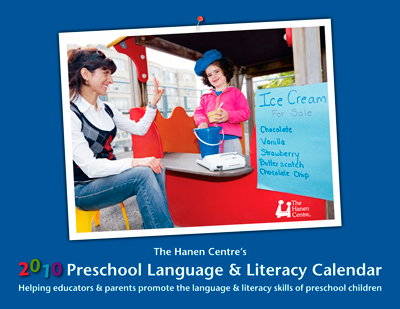
The Hanen calendar is also a great tool for every parent of a preschooler aged 2 ½ to 5 years old. It offers twelve steps to get children ready for school and gives tips on how to get conversations going, and in everyday situations like daily routines. “It gives you tips on what the teacher may be doing at preschool so that you can do at home to make sure your child is on track,” says Banisch.
By the time my own son turned three, he was caught up to his peers. Early intervention is crucial. “Seek the help of the services of a Speech-Language Pathologist and it can take a while,” says Weitzman. The window of opportunity is better when children are young.”
 The Hanen Centre is a local agency in Toronto with Hanen-certified speech-language pathologists in the U.S., U.K. and Australia. The Centre has developed books and DVD’s that can be purchased at www.hanen.org.
